 Just Clean
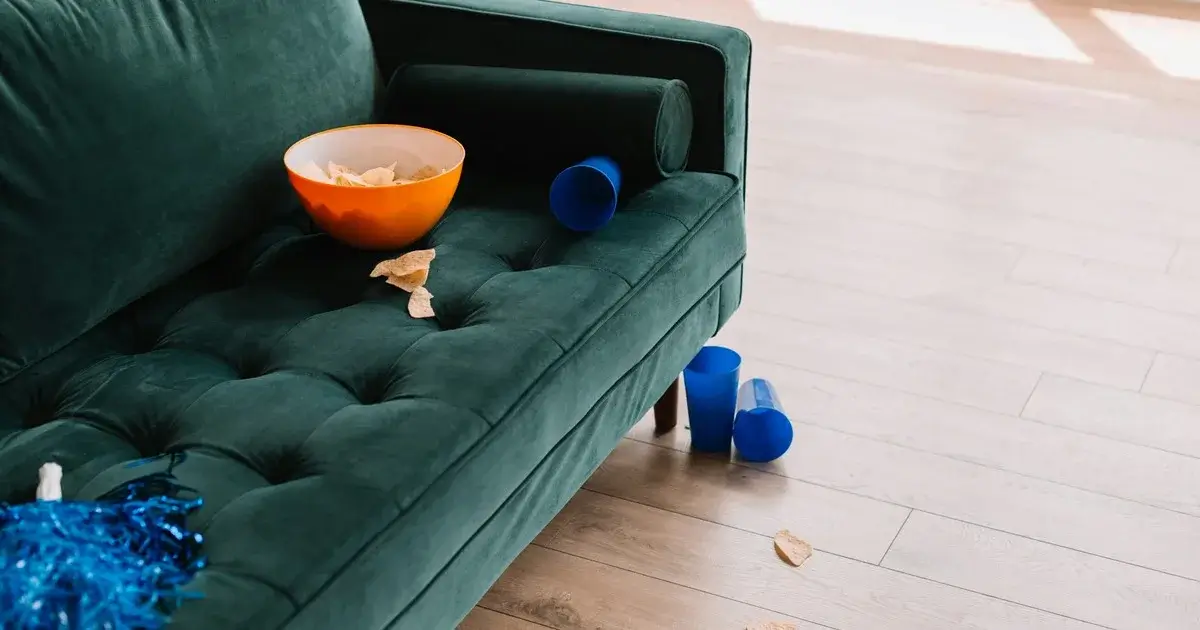
A dark stain on a light sofa, and every second counts. Fresh stains can in most cases be fully removed, dried-in ones often no longer. This guide shows, for the five most common stain types, red wine, coffee, pet urine, grease and ink, what helps immediately, which home remedies are safe and where the line to professional upholstery cleaning runs. It works for classic fabric sofas and fabric couches alike.
⚠️ Important: never rub stains, always dab gently.
Rubbing pushes the dirt deeper into the fibres and can cause watermarks or light rings. This one rule saves more sofas than any special product.
First rule: act fast and correctly
Before we get to the individual stain types, three principles that apply to all sofa and couch stains:
- Never rub, always dab. Rubbing pushes the stain deeper into the fabric and damages the fibre.
- Work from the outside inwards. This prevents the stain from getting bigger.
- Check the material code. The label under the seat cushion usually has a letter, it decides what you may use.
- W = water-based cleaners only
- S = solvent-based cleaners only (e.g. cleaning naphtha)
- WS = both allowed
- X = vacuum only, cleaning only by a specialist
Always test every product first on an inconspicuous spot (back, under the cushion). What works on a microfibre sofa can permanently damage velour.
The stain is getting worse or you are unsure about the fabric?
Send us a photo via WhatsApp, we will tell you honestly whether home remedies are still sensible or whether a professional upholstery cleaning is the better way.
Which sofa fabric needs special care?
Before reaching for a home remedy, it is worth taking a look at the fabric of your sofa or couch. Most permanent damage from DIY cleaning happens because a product was used that is unsuitable for the material.
- Microfibre: usually easy to care for. Tolerates a mild dish-soap solution and gentle dabbing well. Watermarks can appear if only a spot is cleaned, better to dampen the whole seat lightly and let it dry evenly.
- Velour and velvet: very sensitive to watermarks and mechanical stress. Mind the pile direction, always dab in the same direction, never rub or brush when damp. For visible stains, professional cleaning is often the better choice straight away.
- Linen: reacts sensitively to harsh home remedies, tends towards discolouration and watermarks. A test on an inconspicuous spot is a must. With coloured linen fabrics, be careful with dish soap and baking soda.
- Corduroy: sensitive like velour. Do not rub or brush when damp, the ribbed structure can be permanently flattened.
- Real and synthetic leather: need different care than fabric sofas. Do not apply water over a large area, no dish-soap solution, no microfibre cloths with pressure. Special leather cleaners or professional cleaning are safer here.
- Unknown fabric or missing care label: do not try anything with water or solvent yourself. Always test first on an inconspicuous spot (back, under the cushion) or ask a specialist.
Unsure about the fabric? Send us a photo via WhatsApp, we will tell you honestly which approach makes sense for your exact material and where the risks lie.
Removing red wine stains from the sofa
Red wine is one of the most stubborn stains, the tannins bind quickly to textile fibres. With fresh wine, the first five minutes count.
Immediate steps for a fresh stain
- With an absorbent cloth or kitchen paper, dab from the outside inwards until nothing more is absorbed. This direction prevents the stain from spreading further.
- Sprinkle salt or baking powder generously on the damp stain, it acts like a sponge. Let it work for 15 minutes, then vacuum.
- Dissolve mild dish soap (1 tsp) in 250 ml of lukewarm water, dab with a white cloth.
- Dab again with clean water, cover with a dry cloth.
For a dried-in red wine stain, home remedies usually no longer work, the tannins have penetrated the fibre. Only deep cleaning with an extraction process helps here. For older wine stains or light fabrics (linen, cotton) we recommend a professional sofa cleaning, we work gently on the fibres with dry extraction and also neutralise deep-seated discolouration.
What you should not do
- Use hot water, fixes the stain permanently
- Rub with a brush, damages the fibre
- The white-wine trick, does not work reliably on upholstery
Coffee stains on the upholstery
Coffee soaks into upholstery quickly, but rarely leaves permanent discolouration, if you react correctly. This applies to sofas and couch models with a fabric cover just as much as to upholstered chairs.
Step by step for a fresh coffee stain
- Cold water, never warm, warm fixes the tannins.
- Dab with a white cloth from the outside inwards.
- Mild dish soap in cold water (1 tsp per 250 ml), dab the stain.
- For milk coffee: baking powder on the damp spot, let it work for 10 minutes, vacuum, binds the fat content.
- Place a dry cloth on top, a book to weigh it down, absorbs residual moisture.
Dried-in coffee can often be reactivated with gall soap (1 tbsp in 500 ml of cold water). On velour or microfibre sofas, test on a hidden spot first. If the brownish shadow remains, a deep cleaning is sensible, we serve customers in Zürich, Lucerne and across German-speaking Switzerland.
A detailed guide just on coffee: removing coffee from a sofa, what to do?
Neutralising pet urine in the sofa
Urine from a cat or dog is not just a stain problem, the smell soaks into the upholstery interior and can prompt animals to mark again. A quick reaction decides whether the sofa can be saved.
Act immediately: the first 30 minutes
- With thick cloths or kitchen paper, absorb as much liquid as possible, press instead of rubbing, work from the outside inwards so the urine does not spread further.
- Lukewarm water on the spot, dab again, dilutes the urine in the upholstery.
- Apply an enzyme cleaner from a pet shop, enzymes break down urea and odour molecules. Dwell time according to the manufacturer, usually 10–15 minutes.
- Dab again with clean water, cover dry.
Home remedies as a stopgap
If no enzyme cleaner is at hand:
- Vinegar-water mixture 1:1, neutralises alkaline urine
- Baking soda sprinkled on after it has partly dried, let it work for several hours, vacuum
If the urine has penetrated through the cover into the upholstery, surface products are no longer enough. You will find the full emergency guide in our guide on pet urine on the sofa.
Grease stains: oil, butter, mayonnaise
Grease bonds with the upholstery fibres and cannot be dissolved with water alone. The trick: first absorb, then emulsify.
Step by step
- Carefully scrape off the excess with the back of a spoon, do not press it into the fabric.
- Apply cornflour, corn starch or baby powder generously, let it work for 30 minutes, it soaks up the grease.
- Vacuum the starch thoroughly.
- Dish soap and warm water (1 tsp / 250 ml), dish soap is specifically grease-dissolving. Dab with a white cloth.
- Dab again with clean water, let it dry.
Do not experiment yourself on old grease stains on velour or microfibre sofas: solvent cleaners can cause ring marks. A professional sofa cleaning works with targeted grease dissolvers and dry extraction without visible rings.
Dissolving ink stains from the upholstery
Ink (ballpoint, felt-tip, printer) is one of the most difficult stain types, the pigments bind very quickly. Success is only realistic with fresh stains.
Method for fresh ballpoint ink
- Apply isopropanol (at least 70%) or colourless hairspray (contains alcohol) to a white cotton cloth, not directly onto the sofa.
- Dab from the outside inwards, change the cloth often (otherwise you spread the ink).
- When ink transfers to the cloth, repeat until nothing more transfers.
- Dab again with mild dish soap in cold water, then clean water.
Alcohol can dissolve colour out of the upholstery, be sure to test on a hidden spot first. On velour, suede or colour-intensive fabrics we recommend not starting yourself at all. The risk of watermarks or colour loss is too high. Here a specialist cleaning is the safe way.
The 5 most common mistakes with sofa and couch stains
Most permanent damage to a couch is caused not by the stain itself but by the wrong reaction. These five mistakes are the ones we see most often in customer enquiries:
- Rubbing instead of dabbing, pushes the stain deeper into the fabric and damages the fibre structure.
- Too much water at once, causes watermarks and visible rings that are harder to remove than the original stain.
- Wrong home remedy without a test, bleach, vinegar on coloured fabrics or aggressive all-purpose cleaners often lead to discolouration.
- Cleaning only a spot, anyone who treats only the stain risks a lighter circle in the fabric. Better: dab a larger area or treat the whole seat.
- Waiting too long, after 24–48 hours a stain is often absorbed and only removable with professional deep extraction.
When home remedies are no longer enough
As well as home remedies work on fresh stains, in some situations they are the wrong way. A professional sofa cleaning is usually sensible for:
- Older stains (2–4 weeks or longer), pigments are fixed in the fibre
- Pet urine that has penetrated through the cover into the upholstery interior
- Large-area soiling or several stains in one place
- Delicate fabrics such as velour, velvet, linen, suede or real leather
- Several failed cleaning attempts, each further attempt increases the risk of lasting damage
- Watermarks and rings after improper self-cleaning
- Odour problems despite surface cleaning (urine, smoke, mould)
- Material code «X» on the label
- Before moving out of a rented flat, the landlord expects hygienic cleanliness
We work across German-speaking Switzerland, in the cantons of Zürich, Lucerne, Zug, Basel, Bern, St. Gallen, Solothurn, Aargau, Obwalden, Nidwalden and Schwyz (an 11-canton service area). Before every cleaning we carry out an honest material check and name the individual cost before the work begins, flat-rate prices would be dishonest, because every sofa is different. After cleaning, the drying time is 8–10 hours.
Already tried several home remedies?
The sooner a stain is treated professionally, the higher the chance of avoiding watermarks, odours or permanent discolouration. Send us a photo, we assess the fabric and tell you honestly whether a deep cleaning is still sensible.
Frequently asked questions about sofa and couch stain removal
Can old sofa stains still be removed?
Dried-in stains (older than 48 hours) can rarely be fully removed with home remedies, because the pigments have penetrated the fibre. With professional deep extraction a significant improvement is often possible, no reputable provider can guarantee 100% residue-free results. A free on-site check provides clarity.
Does baking soda help against sofa stains?
Baking soda (baking powder) works well on fresh, damp stains: it binds liquid and odour, especially with red wine, milk coffee or light grease splashes. For dried-in or pigmented stains baking soda is not enough, then a real cleaning with a dish-soap solution or professional extraction is needed.
How do you remove watermarks on a sofa?
Watermarks and dry rings appear when only a spot was cleaned with too much water. Solution: evenly dampen the whole seat or backrest with a light dish-soap solution and then let it dry evenly. This makes the visible ring disappear. For stubborn watermarks on delicate fabrics, a professional treatment is the safe way.
Can every stain be removed from a sofa?
No. Fresh stains have a very high success rate. Dried-in, older or combined stains (e.g. wine plus heat) can leave permanent shadows. We do not promise a 100% result, but the maximum possible improvement with professional methods after an on-site material check.
Why no hot water on stains?
Heat permanently fixes most organic stains (wine, coffee, blood, protein) in the fibre. Always use cold or at most lukewarm water.
What do I do with an unknown material code?
If the label is missing or illegible: do not try anything with water or solvent yourself. An on-site material check by a specialist takes a few minutes and is non-binding.
Which home remedies should I never use on a sofa?
Bleach, hydrogen peroxide on coloured fabrics, aggressive all-purpose cleaners, acetone on synthetic fibres. These products can dissolve fibres or permanently remove colours.
When should you book a professional sofa cleaning?
At the latest when one of the following applies: an old or repeatedly treated stain, pet urine inside the upholstery, visible watermarks, a delicate fabric (velour, velvet, suede) or a planned handover of a flat. A general deep clean every 2–3 years also noticeably extends a sofa's lifespan.
How long does a professional sofa cleaning take?
The actual cleaning takes 60–120 minutes depending on the sofa size. Afterwards the upholstery needs 8–10 hours of drying time before it should be used again.
What does professional upholstery cleaning cost in Switzerland?
The cost depends on size, material and degree of soiling. Realistic ranges and example prices can be found in our cost guide Upholstery cleaning Switzerland 2026.
Stain gone or worried about the material?: We check your sofa for free
If a stain stays visible despite all home remedies, or if you would rather play it safe with a tricky material: we check your sofa on site free of charge, say honestly what is possible, and name the individual price before the work begins.
- 📞 Call: +41 79 522 29 19
- 💬 WhatsApp: Send a photo & start a chat
More from our guide:
- Clean your sofa yourself or call a pro, the honest decision aid
- Removing pet urine from the sofa, emergency guide
- Dust mites in the mattress: what really helps, allergy & sleep hygiene
- What does upholstery cleaning cost in Switzerland 2026, transparent price overview