 Just Clean
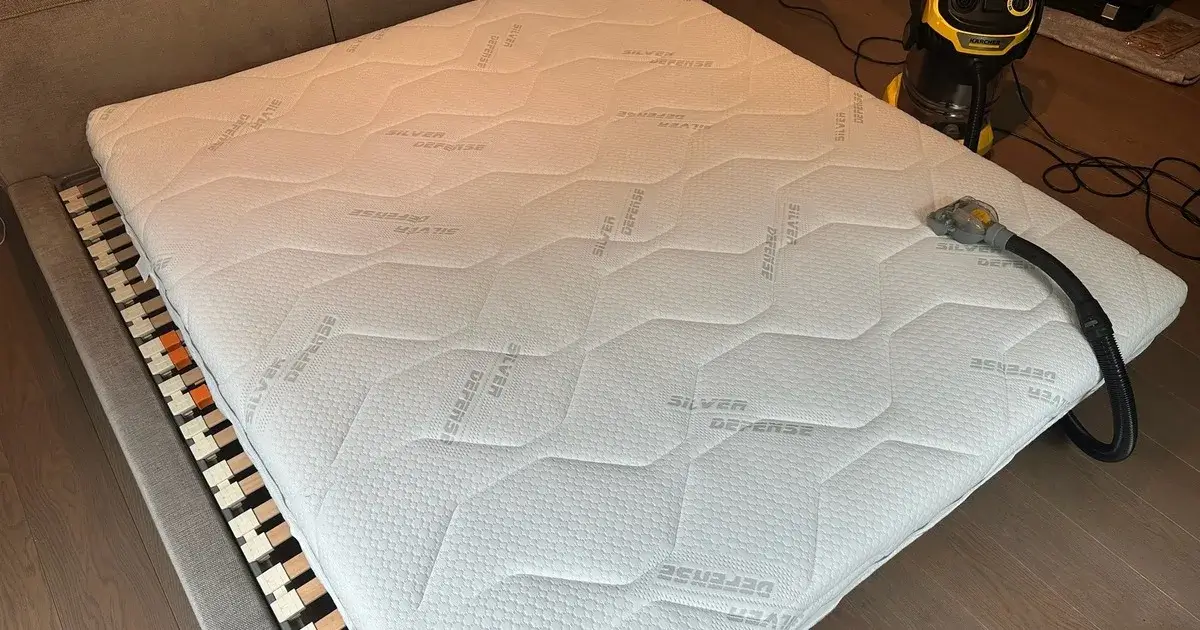
Dust mites live in every mattress, tiny arachnids that feed on skin flakes. For most people they are invisible housemates. For around 20% of the Swiss population with an allergic predisposition (source: aha! Swiss Allergy Centre), their excretions trigger morning sneezing, a blocked nose or asthma attacks. This guide shows what really helps in everyday life, what doesn't, and when a professional mattress cleaning in German-speaking Switzerland is the next sensible step.
In this guide
- What are dust mites and why are they a problem?
- Symptoms of a dust-mite allergy
- What you can do yourself (everyday life)
- Can you remove dust mites from the mattress yourself?
- When professional mattress cleaning makes sense
- How often should a mattress be professionally cleaned?
- Mattress cleaning in your region (Switzerland)
- Frequently asked questions about mites and mattress cleaning
What are dust mites and why are they a problem?
Dust mites (Dermatophagoides) are arachnids 0.1–0.5 mm in size. They are not poisonous, do not bite and transmit no diseases. The problem is their excretions: faecal particles and dead mite bodies contain proteins that trigger an allergic reaction in sensitised people.
The mites' favourite environment in Swiss bedrooms:
- Temperature 20–30 °C, matches typical room warmth
- Humidity 65–80%, reached overnight through breathing moisture and sweat
- Food: skin flakes, every person sheds around 1.5 g of them daily, a large part of which ends up in bed
Over the years, skin flakes, house dust, mite residues and allergens accumulate in every mattress, which is why older mattresses often become more problematic for allergy sufferers. In Switzerland a mattress is replaced on average every 8–10 years; during that time a stable mite population builds up.
Symptoms of a dust-mite allergy
The most common signs appear in the morning after waking up, when the nightly contact with the mattress was most intense:
- Blocked or runny nose, frequent sneezing right after getting up
- Red, itchy or watering eyes
- Irritant cough at night or in the early morning
- Worsening of asthma symptoms
- Skin irritation or eczema flare-ups (especially in children)
- Tiredness despite enough sleep
These symptoms can also have other causes. If you suspect an allergy, the first step is an allergy test at your GP or an allergist, health insurers in Switzerland generally cover the assessment.
If a dust-mite allergy is confirmed: the mattress is usually the most important source in the home. A person spends over 30% of their lifetime in bed, direct, long, warm contact with the allergens.
What you can do yourself (everyday life)
With consistent measures, the mite load can be noticeably reduced in everyday life. Anyone who wants to reduce dust mites in the mattress can, with the right routine for bedding, room climate and vacuuming, achieve a reduction of up to 70% according to studies on low-allergen living environments.
Covers and bedding
- Wash bedding weekly at 60 °C, mites survive 30 °C
- Mattress cover, if removable, quarterly at 60 °C
- Encasings (allergen-proof mattress covers), significantly reduce allergen contact; in Switzerland they are partly covered by health insurers
Climate in the bedroom
- Air the room several times a day (window fully open, 5 minutes)
- Keep humidity below 50%, mites reproduce much less well below that; a hygrometer costs 15 CHF
- Keep the bedroom rather cool (16–18 °C)
Dust and sleeping area
- Vacuum with a HEPA filter (at least filter class H13), normal vacuums blow allergens back out
- Wash soft toys weekly or freeze them for 24 h
- Avoid carpets in the bedroom, use a hard floor if possible
Can you remove dust mites from the mattress yourself?
The honest answer: on the surface yes, completely no.
What works yourself
- Washing bedding and covers at 60 °C, removes mites and allergens from the textiles
- Airing the room and keeping humidity below 50%, reduces the population significantly
- A HEPA vacuum over the surface, removes part of the allergens in the upper area
What does not work yourself
- Deep inside the mattress lives the largest part of the mite population. Neither a vacuum nor baking soda nor a laundry-treatment spray reaches that far.
- Baking soda, vinegar, essential oils, common home remedies, but with no proven effect against mites. They bind odour and a little moisture, nothing more.
- Sun on the balcony, UV light reduces mites only in the top few millimetres, not inside.
- Freezing works for pillows and soft toys; freezing a whole mattress is practically impossible.
What remains if you want to remove dust mites from the mattress: either replace the mattress after 8–10 years, or regularly have a professional mattress cleaning carried out, which reaches the deeper layers of the mattress with deep extraction.
When professional mattress cleaning makes sense
A professional deep clean reaches areas of the mattress that home remedies can hardly get to. It becomes sensible at the latest in these situations:
- A confirmed dust-mite allergy in the household, especially with children
- A mattress older than 3 years and never professionally cleaned
- Visible discolouration, sweat stains or odour
- Asthma or eczema worsen at night or in the morning
- After a longer illness, many customers want a hygienic deep clean in this phase
- After a move into a furnished flat, an unfamiliar mattress with an unknown history
How we work at Just Clean KLG
We use a deep-extraction process with a fibre-friendly cleaning solution that loosens allergen particles, mite residues, skin flakes and sweat residues from the deep layers and vacuums them back out together with the water. This is followed by a hygienic after-treatment, no strong fragrances, no toxic residues. The drying time is 8–10 hours, after which the mattress is fully usable again.
We promise no 100% freedom from mites, that would be dishonest, because new mites settle again over time. What we do promise: after the cleaning the allergen load is significantly reduced and the effect lasts 6–12 months with normal care.
How often should a mattress be professionally cleaned?
The answer depends on the profile:
- With a dust-mite allergy: every 6–12 months
- With asthma or eczema in the household: every 12 months
- General hygiene without allergy: every 2–3 years
- Before moving out of a rented flat or when taking over a used mattress: once
- After illness or visible soiling: as needed
For every first cleaning we carry out a free on-site material check, foam, latex, spring core, visco-memory: each material needs different parameters. We name the individual price before the work begins. Flat-rate prices would be dishonest: a 90×200 single mattress after 2 years is something quite different from a 200×200 boxspring after 8 years.
A rough orientation on price ranges can be found in our cost guide Upholstery cleaning Switzerland 2026.
Mattress cleaning in your region (Switzerland)
Just Clean KLG works on site at the customer's place across German-speaking Switzerland. Travel and the material check are free. Our service area covers 11 cantons, including:
- Zürich
- Lucerne, Central Switzerland
- Zug
- Basel
- Bern
- St. Gallen, Eastern Switzerland
- Further cantons in German-speaking Switzerland on request (Solothurn, Aargau, Obwalden, Nidwalden, Schwyz)
Related guides:
- Cleaning a mattress with home remedies, baking soda, vinegar & co.
- Upholstery cleaning for allergies, a family guide
- Removing mould from a sofa or mattress
- Sofa upholstery cleaning in Switzerland, service overview
- Removing sofa stains by stain type
- Pet urine on the sofa
- Clean your sofa yourself or call a pro
Frequently asked questions about mites and mattress cleaning
Can you see dust mites in the mattress?
No, not with the naked eye, dust mites are 0.1–0.5 mm in size and translucent. Only the consequences are visible: dark discolouration on old bedding or the mattress surface can indicate a high mite load.
Do mites die in the sun?
UV light reduces mites on the surface but does not penetrate the interior of the mattress. Putting a mattress in the sun for a day reduces the population in the top few millimetres, not in the core.
Does baking soda help against mites?
Baking soda binds odour and some moisture but does not kill mites. It is fine as short-term help; it has no lasting effect against the population.
Is a normal vacuum cleaner enough?
Only with a HEPA filter (at least filter class H13). Normal models partly blow fine allergen particles back into the room air.
How long is the mattress unusable after cleaning?
8–10 hours of drying time. We recommend cleaning in the morning so you can sleep on it again in the evening.
Are 100% of the mites removed?
No, and no one can seriously promise that. What is realistic is a significant reduction of the allergen load with a lasting effect of 6–12 months.
Do you wake up with a blocked nose? We check your mattress for free
Do you wake up with a blocked nose or sneeze right after getting up? We check your mattress on site free of charge and tell you honestly whether a deep cleaning makes sense in your case, including a transparent, individual price quote before the work begins.
- 📞 Call: +41 79 522 29 19
- 💬 WhatsApp: Start a chat
More from our guide: